how do glasses work physics
A lens in the eye may bend the wrong way and completely miss its target for clear eyesight. For contacts which are much closer to the lens the size distortion is much less.

Lenses Used In Spectacles Lens Lenses Spectacles
The surface of these lenses serves as our grating upon which the light will diffract.

. S M and L and they are responsible for identifying the colors blue green and red respectively. The glasses would let one colour pass through one eye and the other through the other eye. The light from the sun oscillates in every direction.
Concave lenses correct farsightedness. The viewer wearing linearly polarized glasses can see only one image in each eye the one which has same polarizing angle. Anaglyph glasses are the stereotypical red and blue glasses that people tend to think of when they think of 3D film.
Light hits the glass at an angle and it. There are some more complicated systems as well but because they are expensive they are not as widely used. Because of the different wavelengths of light each color is refracted a different amount.
When the polarized sunglasses are put in front of your eyes the light gets filtered again. The glasses allow only one of the images into each eye because they contain lenses with different polarization. How does the eye change focus.
When the light ray leaves the prism it speeds up again entering the air and refracts a second time. Here in the picture above you can exactly see how this works. It uses the slower speed of light in glass to its advantage by refracting the light twice.
Prescription eyewear otherwise known as eyeglasses prescription sunglasses or contact lenses works by bending light as it enters your eye to allow it to focus perfectly on your retina for a crystal clear viewing field. But the real secret to how diffraction glasses work. The lens of the eye will need to compensate for closer objects.
First the doctor will check your eyes and will offer you measurements for your spectacles. They separate the stereo pair through color filtration. Our eyes detect colors using cones.
There are three types of cones. To better understand this process we first need to understand how the eye itself functions. This can be seen in the figure below.
Glasses are cut to change the focal length of the light entering the eye so it hits the focal point properly and the wearer can see without blurring. How do glasses use waves to work. Type of Lens Physics Behind Glasses To determine the type of lens you need a prior consultation with an eye doctor.
First we produce a high-quality holographic lens that contains thousands of tiny lines. After the light of the sun got reflected by the surface of the water the light oscillates only in the horizontal orientation. Depending on the specifications prescribed by the doctor you need to choose an appropriate lens.
These glasses are used when two images are projected superimposed onto the same screen through orthogonal polarizing filters Usually at 45 and 135 degrees. Typically the left lens has a red filter and the right lens has a blue filter though there are less common variations that may have the colors switched or use. The thicker the glasses the greater the bend the same can be said on how curved the glasses are.
Diffraction glasses like those we design at Rainbow Symphony work on this ancient principle of physics. The polarized glasses allow only one of the images into each eye because each lens has a different polarization. A magnifying glass is usually a convex lens a lens that bulges outwards made of either glass or plastic.
Glasses bends light further to adjust the light that finally goes into your eye eventually correcting the light that goes where it should. This made sure that both our eyes saw the two different images that our brain could interpret as 3D. The blue cones usually operate disjointly whereas for most people the red and green cones might have working regions that overlap.
For glasses that correct for near sighted people this also means a reduction in size of the image on the retina. Nearsighted corretion places virtual images of far objects on the retina. Convex lenses correct nearsightedness by refracting the light toward the bottom and the top of the lens so it pushes the light farther back into the retina.
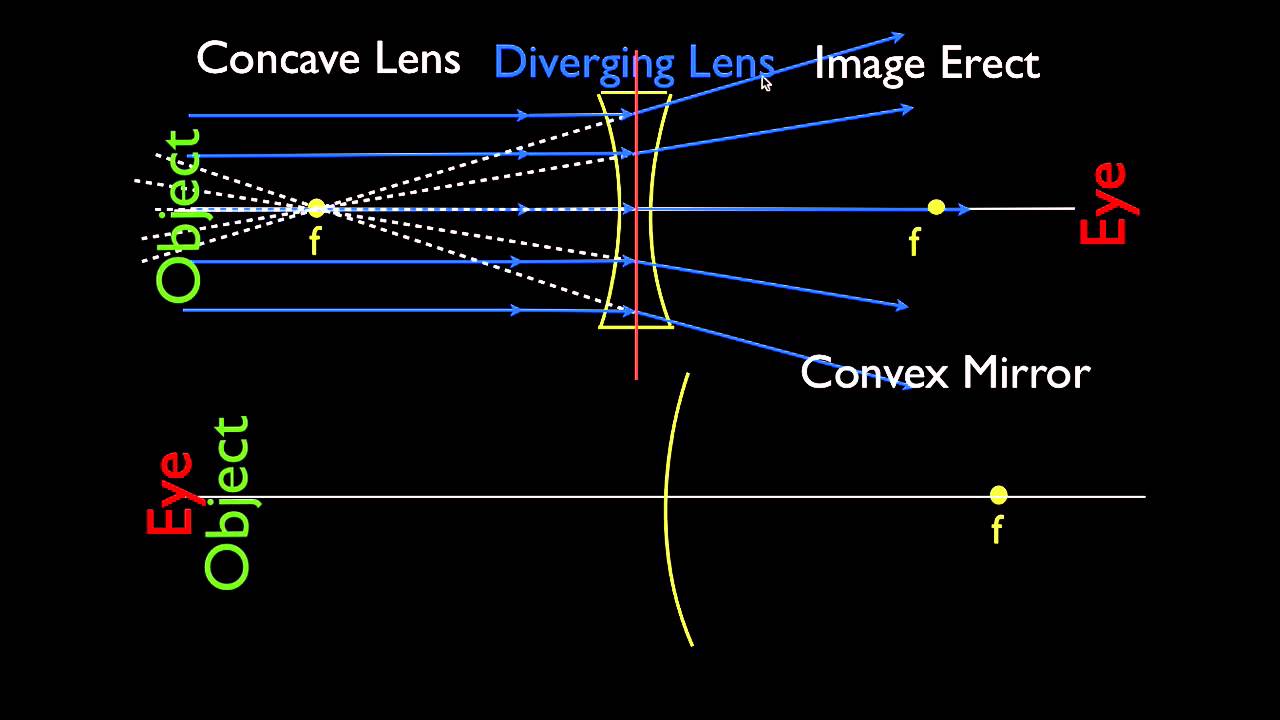
Concave And Convex Lenses And Mirrors Parallel Light Rays Convex Mirror Concave Mirrors Concave

1 Review Of Lenses As Prisms Opticianworks Online Optician Training Optician Training Optician Eye Anatomy

How Do Eyeglasses Work Infographic
Power Of Accommodation Of Eye A Plus Topper Basic Physics Science Notes Physics Classroom

Diagram Of Three Classes Of Levers Physics Classroom Teaching Science Science Lessons

Prism Lenses For Your Eye Glasses Eye Facts Computer Vision Syndrome Physics Notes

Do Yellow Bug Light Bulbs Work 1000bulbs Com Blog Electromagnetic Spectrum Visible Light Visible Light Spectrum

So It S Wednesday And I Got The Day Off Hope You Enjoy These Little Physics Post Feat My New Glasses I Learn Math Online Online Math Help Real Life Math

8 Notes On Optics And Frames Boxing And Edging Optical Optician Training Eye Care Center

Understanding Zoom Lenses And How To Use Them Properly Fisica Formulas Fotografos Lentes

Amazon Com Blue Light Blocking Glasses Anti Glare 0 00 Power Health Personal Care Glasses Readers Glasses Digital Glasses

Simple Eye Diagrams Easy Eye Diagram Labeled Eye Diagram Human Eye Diagram Eye Anatomy Diagram Diagram

How To Get The Thinnest Lenses For Your Prescription Zenni Optical Eyeball Diagram Eye Sight Improvement Physics

Pin On Diy

Pin By Alex Mazika On Colloids Physics Real Glass

Converting A Glasses Prescription To Contact Lenses Tutorial Part 4 Contacts Advice In 2022 Prescription Glasses Prescription Contact Lenses

Lesson 6 Emmetropia Myopia Lesson Learning Optical

Creating A Set Of Rainbow Fringes Using A Diffraction Grating Physics And Mathematics Physics Teaching Ideas Physics Classroom

Physics Optics Light Refraction Snell S Law Prism Physics Refraction Optical